How to Validate an Idea Before You Write Any Code
A four-week validation sequence that costs almost nothing, replaces guesswork with evidence, and tells you whether to build, pivot or stop.
Building is the most expensive way to test an assumption. It is also the most comfortable, which is why founders reach for it first. A disciplined validation process answers the same questions in weeks instead of quarters, and the questions are always the same three: does the problem exist, does it hurt enough to pay for, and can you reach the people who have it.
Week one: twenty problem interviews
Not demos. Interviews. You are not describing your idea — you are asking people to describe their last month.
Good questions sound like this:
- Walk me through the last time you dealt with this.
- What did you use to solve it?
- What did that cost you, in money or hours?
- What happens if you just never fix it?
Bad questions sound like this:
- Would you use a tool that does X?
- Does this sound useful?
The second set produces polite agreement, which is worthless. The first produces stories with numbers in them, which is evidence.
Twenty interviews is the threshold where patterns become visible rather than anecdotal. Below ten, you are hearing personalities. Above thirty, you are usually procrastinating.
What counts as a validated problem
Score each interview against four signals. A problem is real when most conversations hit at least three.
| Signal | What it sounds like | Weight | | --- | --- | --- | | Frequency | "Every week, sometimes daily" | High | | Existing spend | "We pay someone $2,000 a month to do this" | Highest | | Workaround in place | "We built a spreadsheet for it" | High | | Emotional charge | Unprompted frustration, sighing | Medium |
The strongest signal by a distance is existing spend. A person already paying badly for a solution has a budget line, an internal approval path, and an admission that the problem is worth money. A person who says "that would be nice" has none of those things.
Week two: the demand test
Now test whether the problem is worth your solution, without building it.
Three formats, in ascending order of evidence quality:
- Landing page with a real call to action. Not "join the waitlist" — that measures curiosity. Use "book a 20-minute setup call" or "pre-order for $X." Conversion on a specific commitment is far more informative than an email capture.
- Concierge delivery. Deliver the outcome manually for three to five customers. If your product is automated reporting, make the reports by hand at 6am. You learn the real workflow, and the customers are paying for the outcome, not the software.
- Letter of intent or pre-payment. For B2B, a signed LOI or a deposit is the only signal that survives contact with a procurement department.
A useful benchmark: from cold, targeted traffic, a 2-5% conversion to a real commitment means something. Below 1%, either the message is wrong or the problem is not urgent.
Week three: do the unit economics on paper
Before any code, write down the arithmetic that has to be true for the business to work.
| Input | Your estimate | Sanity check | | --- | --- | --- | | Price per customer per month | $200 | Would three interviewees have paid it? | | Gross margin | 80% | What are delivery costs really? | | Expected monthly churn | 3% | Average customer life = 33 months | | Lifetime value | $200 x 0.8 x 33 = $5,280 | — | | Affordable acquisition cost | under $1,760 (LTV/CAC of 3) | Can you actually acquire for that? |
If the only channel you can name costs more per customer than a third of lifetime value, the business does not work at that price — and no amount of engineering fixes it. Change the price, the segment, or the channel now, while changing them is free.
Week four: build the smallest thing that can fail
Now you build — but you build the narrowest possible version aimed at the one workflow the interviews kept returning to. Not a platform. One job, done completely, for the five people who already said yes.
Scope discipline test: if you cannot describe the first version in one sentence without the word "and", it is too big.
Common mistakes
- Interviewing friends. They protect your feelings, which destroys the data.
- Pitching during problem interviews. The moment you describe your solution, the interviewee switches from reporting to being polite.
- Treating a waitlist as demand. Free interest converts at a fraction of what founders assume, often under 5%.
- Validating with the wrong buyer. In B2B, the user and the budget holder are frequently different people with different problems.
- Stopping at "people liked it". Liking is not buying. Only commitment — money, a signed document, or a calendar slot — is evidence.
When the answer is no
Validation that kills an idea in four weeks is a success. The cost was a month; the alternative was eighteen months and a team. Most experienced founders have one or two of these behind them and describe them as the cheapest thing they ever did.
Pivot rules of thumb: if the problem is real but your solution is wrong, keep the segment and change the product. If the problem is not real, keep nothing except what you learned about the customer.
How the simulator models it
Garage to IPO starts you in the garage with limited cash and a market that responds to fit, not effort. Pushing product spend into a market with weak demand burns runway without moving traction — exactly the feedback loop validation is designed to give you before real money is involved.
Recording what you learn
Validation produces a lot of information and most of it evaporates within a fortnight unless it is written down in a structure you can query later.
Keep one document per interview with four fields: who they are and their role, the problem in their own words, what they currently spend in time or money, and the exact quote that struck you. Quotes matter — they become your landing page copy, your sales script and, eventually, three slides of your seed deck.
Then maintain a single summary table across all interviews, with one row per person and columns for each of the four validation signals. The pattern is usually visible by interview twelve and unmistakable by twenty. Founders who rely on recollection instead consistently remember the three most enthusiastic conversations and forget the seventeen lukewarm ones.
Two additional habits worth adopting early. Record calls where permitted, because you will hear things on the second listen that you missed while thinking about your next question. And write your conclusion before you look at the table, then check whether the data agrees — the gap between what you expected and what you found is usually the most valuable output of the entire month.
Where to go next
Once demand is proven, the numbers in week three become the ones you live by. Our post on CAC, LTV and payback takes them apart properly.
Common questions
- How many customer interviews are enough?
- Around twenty. Below ten you are hearing individual personalities rather than patterns, and beyond thirty you are usually delaying the decision.
- Is a waitlist good validation?
- Weak validation. Free sign-ups measure curiosity. A booked call, a signed letter of intent or a pre-payment measures demand.
- What if validation says no?
- That is a successful outcome. You spent a month instead of eighteen. Keep the customer knowledge, and change either the product or the segment depending on whether the problem itself was real.
Keep reading
Cofounder Agreements: The Conversations Nobody Has Until It Is Too Late
Roles, vesting, decision rights, money, and the exit clause — the five agreements that decide whether a cofounder split ends the company or merely hurts.
Month One: The Paperwork That Actually Matters
Incorporation, the name, the IP assignment, the 83(b) election — what a brand new company must get right in its first thirty days, and what can safely wait.
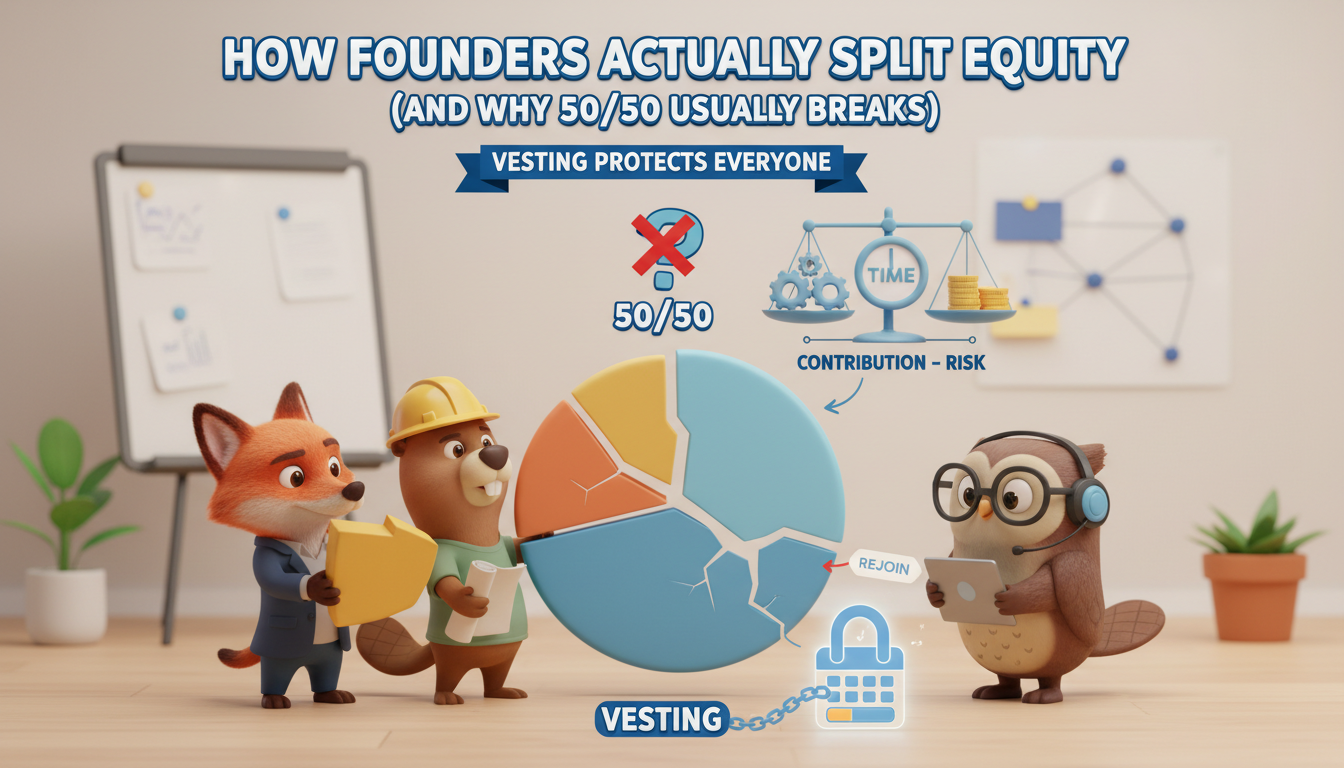
How Founders Actually Split Equity (And Why 50/50 Usually Breaks)
A practical framework for dividing founder equity: what to weigh, why an even split is rarely honest, and how vesting protects everyone when someone leaves.