Cofounder Agreements: The Conversations Nobody Has Until It Is Too Late
Roles, vesting, decision rights, money, and the exit clause — the five agreements that decide whether a cofounder split ends the company or merely hurts.
Cofounder conflict is one of the most common reasons startups die, and it frequently causes the other one: running out of money. What makes it avoidable is that the arguments are predictable. Every founding team eventually has the same five disagreements. Teams that survive had them early, in writing, while everyone still liked each other.
1. Who decides what
Two smart people with equal authority and no tie-breaker produces paralysis, and paralysis in a startup is slow death. Split decision rights by domain, explicitly:
| Domain | Final say | Consulted | | --- | --- | --- | | Product scope and roadmap | CTO | CEO | | Pricing and go-to-market | CEO | CTO | | Hiring within an approved budget | Domain owner | Other founder | | Fundraising strategy and terms | CEO | Board | | Anything above an agreed spend threshold | Joint | — |
The point is not that the assignment is perfect. It is that on any given Tuesday, someone can decide. Write down the three or four categories that require genuine joint agreement — raising money, changing the cap table, firing a founder, selling the company — and let everything else have a single owner.
2. Vesting, and what "leaving" means
Four years, one-year cliff, monthly thereafter, applied to all founders equally. That is the standard and there is little reason to deviate.
The part teams skip is defining departure. Three cases need separate treatment:
- Voluntary resignation. Keep what has vested, stop there.
- Termination for cause. Define "cause" precisely — fraud, conviction, material breach — or it becomes a weapon. Unvested shares are forfeited.
- Termination without cause. Often accompanied by partial acceleration, typically six to twelve months, so that a founder cannot be pushed out one month before a cliff.
Add an acceleration clause for an acquisition. Double-trigger — acceleration only if the company is acquired and the founder is let go — is the market norm and the one investors accept without argument.
3. Time commitment, in hours and in writing
"Full-time" is not a definition. A cofounder with a consulting client, a teaching job, or another startup is a part-time cofounder holding full-time equity, and resentment builds quietly for months before anyone says it.
State the commitment: full-time from a specific date, or explicitly part-time with an equity allocation that reflects it. If one founder joins full-time in month one and another in month nine, either the vesting start dates differ or the equity split does.
4. Money: salaries, expenses, and the loan nobody mentioned
Agree in advance:
- When founders start taking a salary and at what level — typically at the seed round, at a deliberately modest number.
- What personal spending is reimbursable before there is a bank account.
- Whether founder loans to the company are loans or contributions, and what happens to them at the first priced round.
A founder who quietly put $40,000 of personal money into the company and never documented it will, at some point, want it recognised. Documented at the time, it is an easy conversation. Raised eighteen months later, it feels like a claim.
5. The exit clause
The hardest paragraph to write and the one that saves the company. It should answer: if one of us wants out, or the rest of us want them out, what happens mechanically?
A simple buy-sell provision covering valuation method, payment timing, and board seat resignation turns a potential lawsuit into an administrative process. Companies without one spend six figures and nine months discovering their answer in front of a lawyer.
The equity split conversation itself
Equal splits are common and frequently correct, but they should be a conclusion, not a default chosen to avoid a difficult hour. Factors worth weighing openly: who had the idea, who is taking the bigger financial risk, who brought the IP or the initial customers, who is full-time from day one, and who is taking the CEO role.
A useful framing: the split should be one both founders would still consider fair after two years of the company going badly. Splits that only feel fair in the success case are the ones that break.
Common mistakes
- Deciding equity over drinks and never documenting it. Memory is not a cap table.
- Avoiding vesting because it signals distrust. It signals professionalism. Every investor will require it anyway.
- Leaving "cause" undefined. An undefined term is decided by whoever can afford the longer legal argument.
- Giving an advisor or early helper founder-level equity. Advisors get 0.1-1% on a two-year vest, not 10%.
- Assuming the agreement replaces the relationship. It does not. It gives the relationship a structure to fail into safely.
How the simulator models it
In Garage to IPO the founder ledger tracks ownership across every run, and equity given away in the garage stage compounds through seed, growth and IPO. The game makes the arithmetic visible in a way real cap tables usually do not until the term sheet arrives — which is precisely when founders discover that a handshake from year one now costs them eight figures.
The annual conversation
An agreement written once and filed is worth less than one revisited. Put a recurring calendar entry — once a year, two hours, off-site, no laptops — to walk through four questions honestly.
- Is the role split still right? Companies change faster than titles. The person who ran sales at ten customers may not be the right person at five hundred, and the earlier that is said out loud, the less damage it does.
- Is the time commitment still equal? Life happens: illness, children, family obligations, burnout. These are normal and manageable when acknowledged, and corrosive when quietly resented.
- Is anyone unhappy with the equity split? Asking directly is uncomfortable for ten minutes. Not asking is expensive for years.
- Does anyone want out? A founder who is mentally done and staying out of guilt is worse for the company than one who leaves cleanly with vested shares.
The most useful framing for these conversations is that the company's interests and the founders' friendship are different things. Protecting the second by avoiding hard conversations reliably damages the first, and then the second anyway. Teams that talk plainly once a year rarely need a lawyer to talk for them later.
Where to go next
Pair this with how founders actually split equity for the split itself, and month one paperwork for the documents that make any of it enforceable.
Common questions
- What is standard founder vesting?
- Four years with a one-year cliff and monthly vesting afterwards, applied equally to all founders, with double-trigger acceleration on an acquisition.
- Should cofounders always split equity equally?
- Often, but it should be a considered conclusion rather than a default. Weigh full-time start dates, financial risk taken, IP contributed and role, and test whether the split still feels fair if the company goes badly.
- Do we need a lawyer for a cofounder agreement?
- For the core documents, yes. Formation, stock issuance and vesting terms are the cheapest legal work you will ever buy relative to the cost of fixing them later.
Keep reading
How to Validate an Idea Before You Write Any Code
A four-week validation sequence that costs almost nothing, replaces guesswork with evidence, and tells you whether to build, pivot or stop.
Month One: The Paperwork That Actually Matters
Incorporation, the name, the IP assignment, the 83(b) election — what a brand new company must get right in its first thirty days, and what can safely wait.
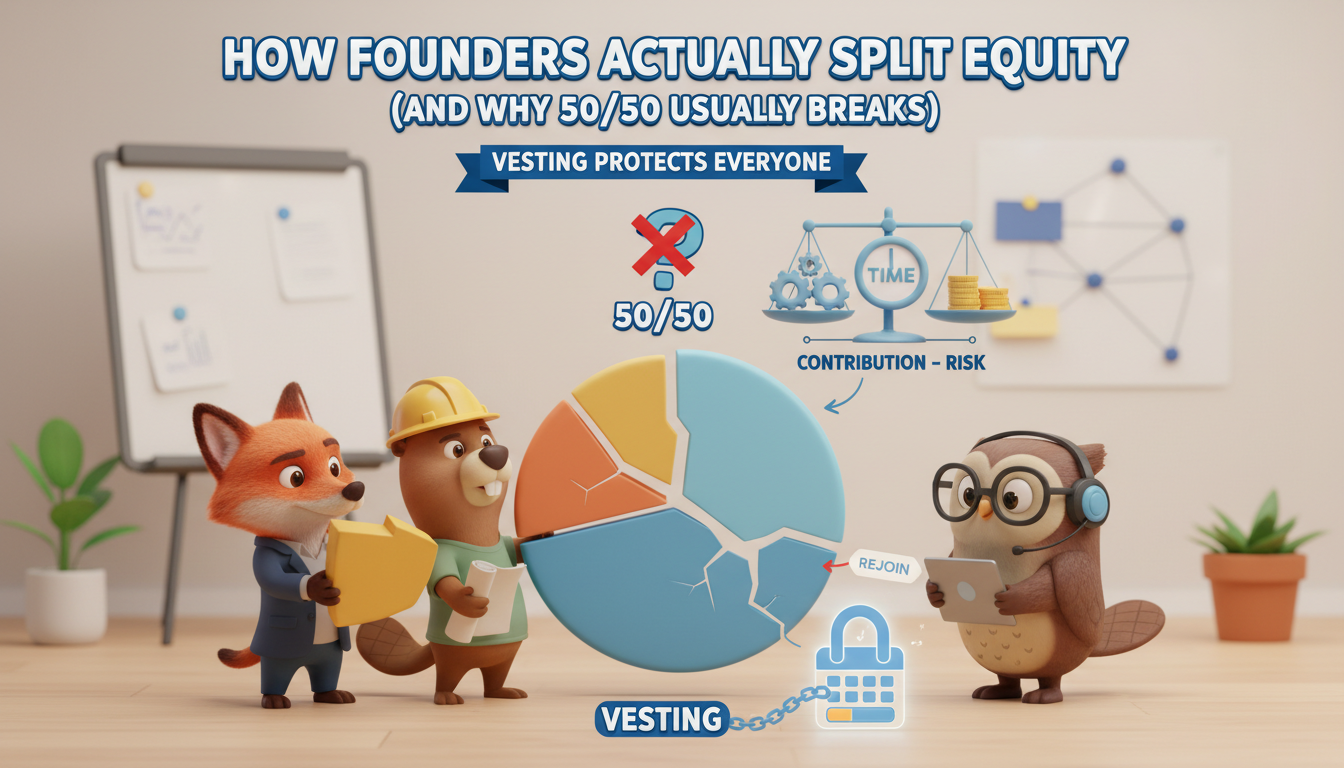
How Founders Actually Split Equity (And Why 50/50 Usually Breaks)
A practical framework for dividing founder equity: what to weigh, why an even split is rarely honest, and how vesting protects everyone when someone leaves.