How Founders Actually Split Equity (And Why 50/50 Usually Breaks)
A practical framework for dividing founder equity: what to weigh, why an even split is rarely honest, and how vesting protects everyone when someone leaves.
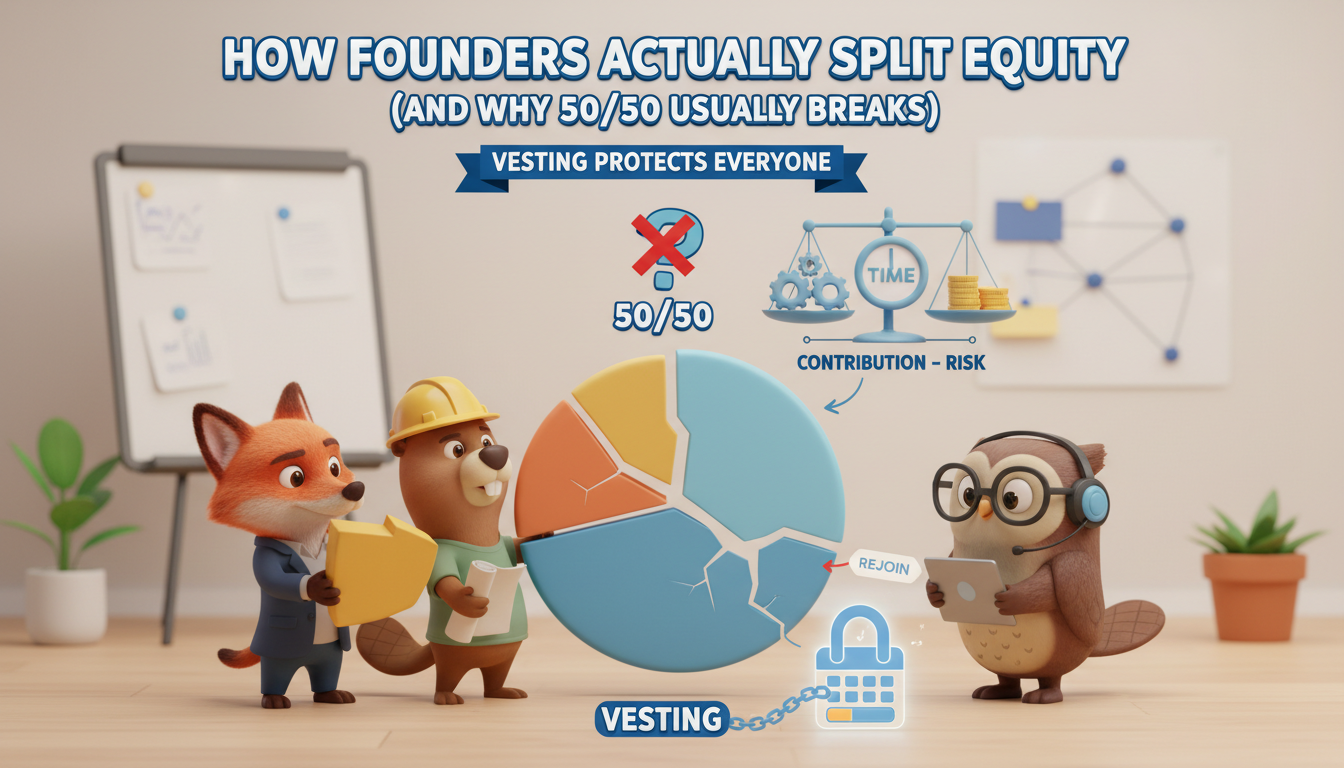
Founder equity is the first irreversible decision most startups make, and it is almost always made in the worst possible conditions: early, fast, between friends, with no money on the table and no data to argue about. The split feels abstract the week you make it. Four years later it is the single largest financial fact in everyone's life.
The even split is a decision to not decide
Two founders meet, agree the idea is great, and write down 50/50 in ten seconds. It feels fair. It feels like trust. What it usually is, is conflict avoidance — the number that lets everyone skip the uncomfortable conversation about who is actually doing what.
The problem is not the number. The problem is that nobody tested it. If one founder quits their job in month one and the other stays employed for a year, that 50/50 is now a transfer of wealth from the person taking risk to the person who isn't. If one founder writes the product and the other "handles business," and business means coffee meetings, the split will feel obviously wrong long before it is legally fixable.
What actually deserves equity
Equity pays for risk and future commitment. It does not pay for the past, and it does not pay for enthusiasm. When you sit down to split, weigh these honestly:
- Opportunity cost. Who gave up a salary, and how big a salary? Who is still hedging?
- Cash in. Money that went into the company before there was a company is real and should be recognised — sometimes as equity, often better as a convertible note.
- Time commitment going forward. Full-time and part-time are not the same input, and pretending otherwise poisons the relationship.
- The idea. Worth something, but far less than founders think. Ideas are cheap; execution windows are short.
- Critical scarce skill. If one person is the only reason the product can exist, that is leverage, and the market prices leverage.
- Existing traction. Revenue, users, or a signed customer brought to the table is the closest thing to hard evidence you will get.
Score each one. Argue about the weights, not the totals. If you cannot have that conversation now, you certainly cannot have it during a down round.
Vesting is the actual protection
The split matters less than the vesting schedule attached to it. Standard in the US is four years with a one-year cliff: nothing vests until month twelve, then it vests monthly. If a co-founder leaves in month eight, they leave with nothing, and the company keeps the stock it needs to hire their replacement.
Founders resist this because it feels like distrust. It is the opposite. Vesting is the promise that whoever stays will not be carrying a passenger on the cap table for a decade. Every investor will require it anyway — do it before they ask, and do it while you still like each other.
Two details people skip:
- Acceleration on acquisition. Single-trigger acceleration vests everything on a sale. Double-trigger vests on a sale and termination. Double-trigger is the market standard and the one buyers prefer.
- Repurchase rights. The company should be able to buy back unvested — and sometimes vested — shares from a departing founder at the price paid.
Run the numbers forward, not backward
Before you sign anything, model the cap table three rounds out. A 50/50 split with a 15 percent option pool and three rounds of 20 percent dilution leaves each founder around 27 percent. Add a fourth round or a bigger pool and you are in the teens. That is normal — a small slice of something is the entire point — but you should see it before you agree, not after.
The founders who survive this decision have one thing in common: they treated it as a negotiation between adults who intend to work together for a decade, not as a test of friendship. Write it down, get it signed, and then never think about it again.
Common questions
- Is a 50/50 split ever right?
- Yes, when two founders genuinely carry equal risk, equal time and equal decision authority. It becomes a problem when it is chosen to avoid a hard conversation rather than because it reflects reality.
- What vesting schedule is standard?
- Four years with a one-year cliff is the norm in the US. Nothing vests for twelve months, then it vests monthly for the remaining three years.
- Should an advisor get founder equity?
- No. Advisors are usually granted 0.1 to 1 percent on a two-year schedule, not founder-level stock.