Month One: The Paperwork That Actually Matters
Incorporation, the name, the IP assignment, the 83(b) election — what a brand new company must get right in its first thirty days, and what can safely wait.
Most first-time founders spend their first month on two things that do not matter yet — a logo and a landing page — and postpone the four things that are expensive to fix later. This is the short list of what the first thirty days of a company actually require, in the order a lawyer would do it.
The name: check it before you love it
A name has three separate availability questions, and founders usually only check the third one.
- Corporate name availability in your state of incorporation. Two companies cannot register the same legal name.
- Trademark conflict in your class of goods or services. A federal search takes fifteen minutes. A conflict found two years later costs six figures and your domain.
- Domain and handles. The cheapest of the three to solve and the only one founders check first.
If the name clears the first two, the third is negotiable. A hyphen or a country suffix is survivable. A cease-and-desist after you have printed brand assets and built search ranking is not.
Incorporate — and where
For anything venture-backed, the default is a Delaware C-corporation. Not because Delaware is cheaper, but because its corporate law is the most heavily litigated in the country, which means it is the most predictable, and because institutional investors' documents assume it. An LLC is fine for a consultancy and wrong for a company that intends to issue stock options and take priced rounds; converting later is possible but costs legal fees and a taxable event you do not need.
| Structure | Good for | Cost to form | Conversion pain later | | --- | --- | --- | --- | | Delaware C-corp | Venture-backed startups | $500-$1,500 | None needed | | LLC | Cash-flow businesses, consultancies | $200-$800 | Real: fees plus tax consequences | | Sole proprietorship | Testing an idea alone | $0 | High: no entity to convert |
Issue founder stock immediately, at almost nothing
Founder shares should be issued at formation, when the company is worth essentially zero. Common practice is 10,000,000 authorized shares, with founders buying their allocation at $0.0001 per share — a $1,000 cheque for ten million shares.
Why the timing matters: you pay tax on the difference between what you paid and what the stock was worth. At formation, that difference is zero. Six months and a term sheet later, it is not.
The 83(b) election: thirty days, no extensions
If your founder stock vests — and it should — you must file an 83(b) election with the IRS within 30 days of the grant date. There is no extension, no appeal, no hardship exception.
The election tells the IRS to tax you now, on stock worth nearly nothing, rather than taxing each tranche as it vests at whatever the company is worth then. Miss it, and a founder whose company reaches a $50M valuation can face a tax bill on vesting shares they cannot sell to pay the tax.
Worked example on a four-year vest, 2,500,000 shares per year:
| Scenario | Taxable event | Approximate tax exposure | | --- | --- | --- | | 83(b) filed | $1,000 of value at grant | Effectively nil | | 83(b) missed, company at $50M in year 3 | 2.5M shares vesting at ~$1.25/share | ~$3.1M of ordinary income, no liquidity |
File it. Send it certified mail. Keep the receipt with the corporate records.
Assign the IP to the company
The single most common diligence problem in a seed round is not cap table mess — it is intellectual property that legally belongs to a person, not the company. Every founder, employee and contractor signs an agreement that assigns work product to the company. Two specific traps:
- Work done before incorporation. The prototype you built for eight months belongs to you personally until a written assignment moves it. Assign it explicitly, by name.
- Contractors. In most jurisdictions a contractor owns what they create unless a written agreement says otherwise. A verbal arrangement plus an invoice is not an assignment.
A buyer or lead investor will ask for these documents. Producing them in an afternoon signals a company that is run properly; scrambling to chase a contractor from two years ago signals the opposite, and it slows a round at exactly the point momentum matters.
Founder vesting, even when there is no investor to insist
Vesting protects the founders who stay. The market standard is four years with a one-year cliff, and it applies to everyone including the CEO. If a cofounder leaves in month five with a quarter of the company and no vesting, the remaining founders spend the rest of the company's life diluting themselves around a stranger's static block of equity.
Investors will impose vesting at the first priced round anyway, often resetting the clock. Founders who put it in place voluntarily get to keep the time they have already served.
What can wait
- A logo beyond something legible
- A custom-designed website
- Trademark registration (the search matters now; the filing can follow revenue)
- An accountant on retainer — bookkeeping software is enough until you have payroll
- A board of directors beyond the founders
Common mistakes
- Waiting to incorporate until there is money. Every week of pre-entity work creates IP that must be assigned back later.
- Splitting equity before the vesting conversation. The split and the vesting terms are one negotiation, not two.
- Using a template from the internet for stock issuance. Formation documents are the one place where a few hundred dollars of legal review pays for itself immediately.
- Forgetting the 30-day clock. It is the only genuinely unforgiving deadline on this list.
How the simulator models it
In Garage to IPO, your garage stage runs before any investor is on the cap table, and the choices you make there set the structure everything else inherits. Equity granted early is the cheapest equity you will ever grant, and the ownership percentage you carry out of the garage compounds through every subsequent round. The game compresses the paperwork, but the economics are the same: decisions made when the company is worth nothing are worth the most.
Where to go next
Read our post on how founders actually split equity before you finalise the cap table, and the guides library for the mechanics of dilution across rounds.
Common questions
- Do I have to incorporate in Delaware?
- No, but if you intend to raise venture capital it is the path of least resistance because investor documents assume a Delaware C-corp. A local entity works fine for a business that will not issue preferred stock.
- What happens if I miss the 83(b) deadline?
- There is no extension. You will be taxed on the value of each tranche of stock as it vests, which can create a large tax bill on shares you cannot sell.
- Do I need vesting if there are no investors yet?
- Yes. Vesting protects the founders who stay, and putting it in place voluntarily preserves the time you have already served rather than having an investor reset the clock later.
Keep reading
Cofounder Agreements: The Conversations Nobody Has Until It Is Too Late
Roles, vesting, decision rights, money, and the exit clause — the five agreements that decide whether a cofounder split ends the company or merely hurts.
How to Validate an Idea Before You Write Any Code
A four-week validation sequence that costs almost nothing, replaces guesswork with evidence, and tells you whether to build, pivot or stop.
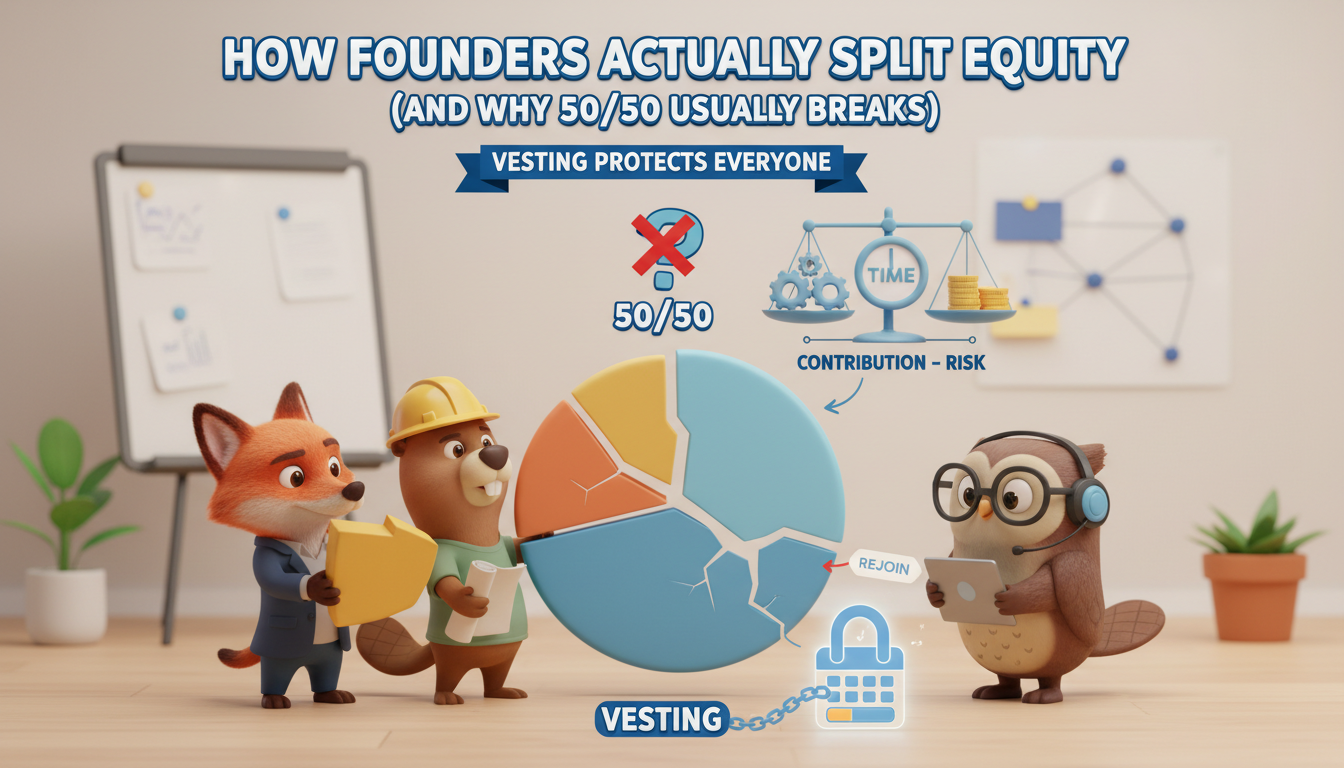
How Founders Actually Split Equity (And Why 50/50 Usually Breaks)
A practical framework for dividing founder equity: what to weigh, why an even split is rarely honest, and how vesting protects everyone when someone leaves.