Life After the Sale: Lock-Ups, Earn-In Years, and What Founders Do Next
The integration year, the money decisions that cannot be undone, and why the identity problem hits harder than the financial one.
The deal closes and almost nothing about your day changes for a while. There is money you largely cannot touch, a job you no longer control, and a version of the next two years that most founders never plan for because they spent all their planning on getting to the signature.
The first ninety days
You are now an employee. Not a metaphor — an actual one, with a manager, a budget approval process and a compensation band.
What typically happens:
- Systems migration. Your tools, email, payroll and security stack move to theirs. It is slower and more disruptive than anyone estimates.
- Reorganisation. Your team gets distributed into functional groups. The engineering manager you spent two years developing now reports into a directorate.
- Roadmap review. Your priorities get re-ranked against a portfolio you do not control.
- Attrition. Some of your best people leave within six months. This is normal and it is not personal — they joined a startup.
Founders who cope best decide in advance which two or three things they will genuinely fight for — usually the team's structure, a product commitment, or customer treatment — and let everything else go. Fighting every change exhausts your credibility in the first month, when you still have the most of it.
Money decisions that cannot be undone
Liquidity creates a short window in which several irreversible decisions get made badly, usually quickly and usually alone.
Build the team before the money lands. A fee-only financial adviser, a tax accountant experienced in equity events, and an estate lawyer. Interview them while the deal is in diligence, not after the wire arrives.
Understand your tax position early. Holding periods, qualified small business stock treatment where applicable, the difference in treatment between cash, stock and earn-out proceeds — these depend on decisions made before closing, not after.
Handle the lock-up properly. If you were paid in public buyer stock, you likely cannot sell for 90-180 days, and your holding is now concentrated in a single company you do not run. Once free to sell, a scheduled programme removes the daily decision and the temptation to time the market.
A reasonable default allocation discussed by most advisers:
| Bucket | Share | Purpose | | --- | --- | --- | | Cash reserve | 1-2 years of expenses | Removes urgency from every future decision | | Diversified long-term portfolio | The majority | The actual outcome of the exit | | Concentrated or high-risk bets | A capped slice you can lose entirely | Angel investing, the next company |
The most common error is treating the whole sum as permanent wealth and adjusting lifestyle to match. The second is deploying most of it into startups within eighteen months, because it is the asset class you know and the one that feels like continuity.
The identity problem
This is the part nobody warns founders about, and it is more disorienting than the financial side.
For years the question "what do you do?" had an answer with a mission attached. Now it is "I work at a large company on a product I used to own", and then eventually nothing at all. Founders routinely describe the twelve months after an exit as the flattest period of their professional lives, including the periods when the company was nearly dying.
Two things help. First, staying through a meaningful part of the integration gives structure while you work out what is next, and finishing well matters to your reputation in a small industry. Second, deliberately not deciding anything for six months. Almost every founder who started the next company within three months of an exit describes it as a reaction rather than a choice.
What founders actually do next
| Path | Suits | Reality | | --- | --- | --- | | Stay and run a larger business unit | People who enjoy scale and systems | Genuine career path; requires accepting corporate life | | Start again | People who like zero-to-one | Second companies are harder; expectations are higher | | Angel investing | Those with strong networks | Real returns take 7-10 years; not an income | | Operator-partner at a fund | Pattern-matchers who like breadth | Competitive; usually needs a notable outcome | | Stop for a while | Almost everyone, at least briefly | The most consistently well-reviewed choice |
Common mistakes
- Quitting the day the lock-up on your retention package cliffs, loudly. The industry is small.
- Buying illiquid assets immediately. Property and private funds tie up capital before you know what you want.
- Saying yes to everything. Advisory roles, angel cheques and board seats accumulate into a calendar with no direction.
- Measuring the next thing against the last one. A second company compared daily to the exit metrics of the first is unlikely to feel successful.
- Neglecting the team you brought over. Their outcome was smaller than yours, and your advocacy inside the buyer matters more than you think.
How the simulator models it
Garage to IPO continues after an exit rather than ending. You bank the proceeds, carry your track record forward, and choose a new venture with a different market, cost structure and difficulty — which is a reasonable model of the real decision, where the money changes the risk you can take but not the work required.
Helping your team through it
Your outcome and your team's outcome are not the same, and the gap is usually large. An early employee with 0.4% of a company sold at $60M, after preferences, may receive a five-figure sum for four years of work. They will be watching how you behave.
Concrete things that matter:
- Explain the waterfall honestly before the deal closes, in a session where people can ask questions. Vague optimism followed by a disappointing statement is the fastest way to lose a team's respect.
- Negotiate for them. Option acceleration, a retention pool and credit for prior vesting are all negotiable, and founders who trade them away for a higher personal number are remembered for it.
- Be specific about titles and levels in the acquiring company before closing. "We will sort it out after" reliably means a downgrade.
- Write references and make introductions for anyone who leaves. You will work with these people again; the industry is much smaller than it looks.
Founders who handle this part well recruit their second company's first ten hires out of their first company's alumni. Founders who do not, spend the next venture explaining themselves.
Where to go next
Read earn-outs, escrow and the real payout for what actually reaches your account, and what IPO day actually looks like for the other version of this ending.
Common questions
- How long is a typical lock-up after an acquisition?
- Ninety to one hundred and eighty days when you are paid in public buyer stock, often alongside a one to three year retention vesting schedule on new equity.
- Should founders start another company right after an exit?
- Most who do within three months describe it as a reaction rather than a decision. Six months of deliberately deciding nothing is the more commonly recommended approach.
- What is the biggest financial mistake after a startup exit?
- Treating the proceeds as permanent wealth and raising lifestyle to match, closely followed by redeploying most of it into startups within the first eighteen months.
Keep reading
Earn-Outs, Escrow, and Why the Headline Number Is Not What You Get
A worked walk from a $60M announcement down to what actually lands in a founder bank account, and which terms to fight for.
How Acquisition Offers Are Actually Priced
Strategic buyers, financial buyers and acquihires value the same company completely differently. Here is what each is paying for, and how the number is built.
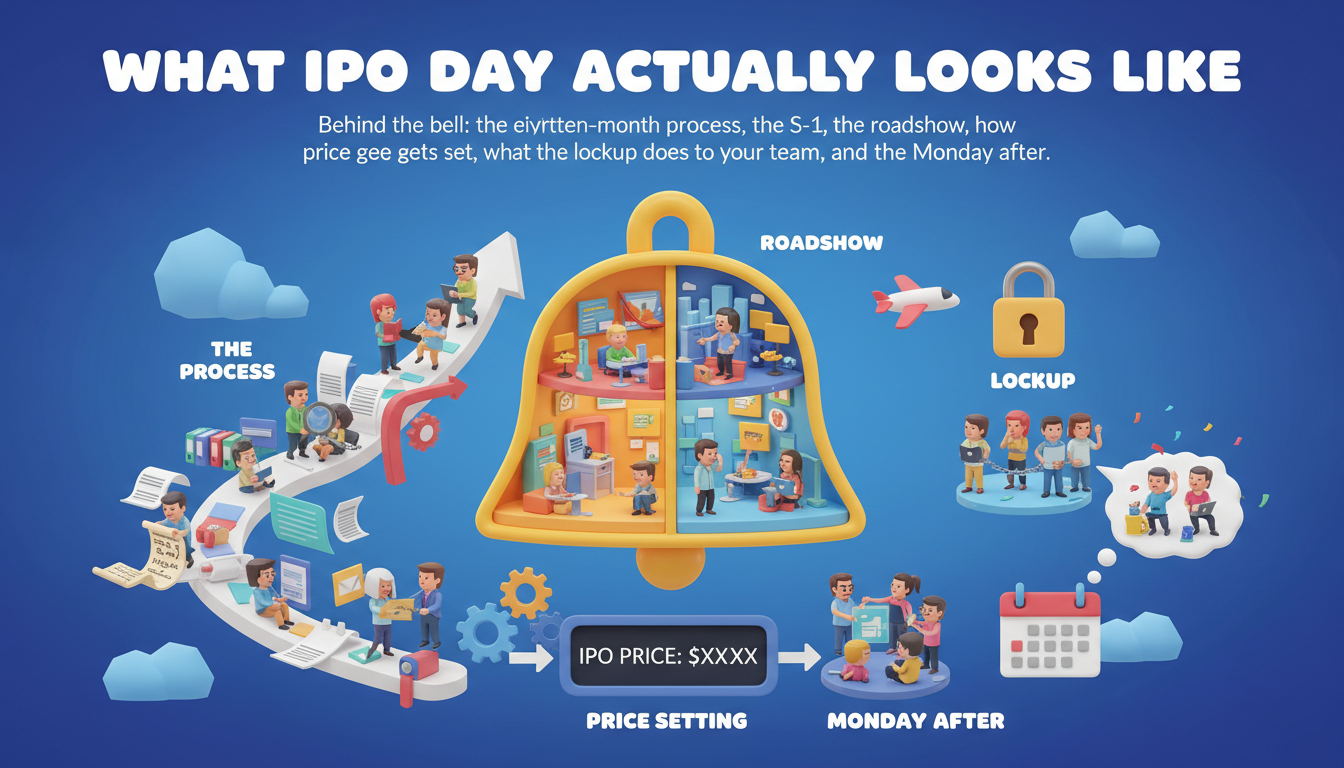
What IPO Day Actually Looks Like
Behind the bell: the eighteen-month process, the S-1, the roadshow, how the price gets set, what the lockup does to your team, and the Monday after.