What IPO Day Actually Looks Like
Behind the bell: the eighteen-month process, the S-1, the roadshow, how the price gets set, what the lockup does to your team, and the Monday after.
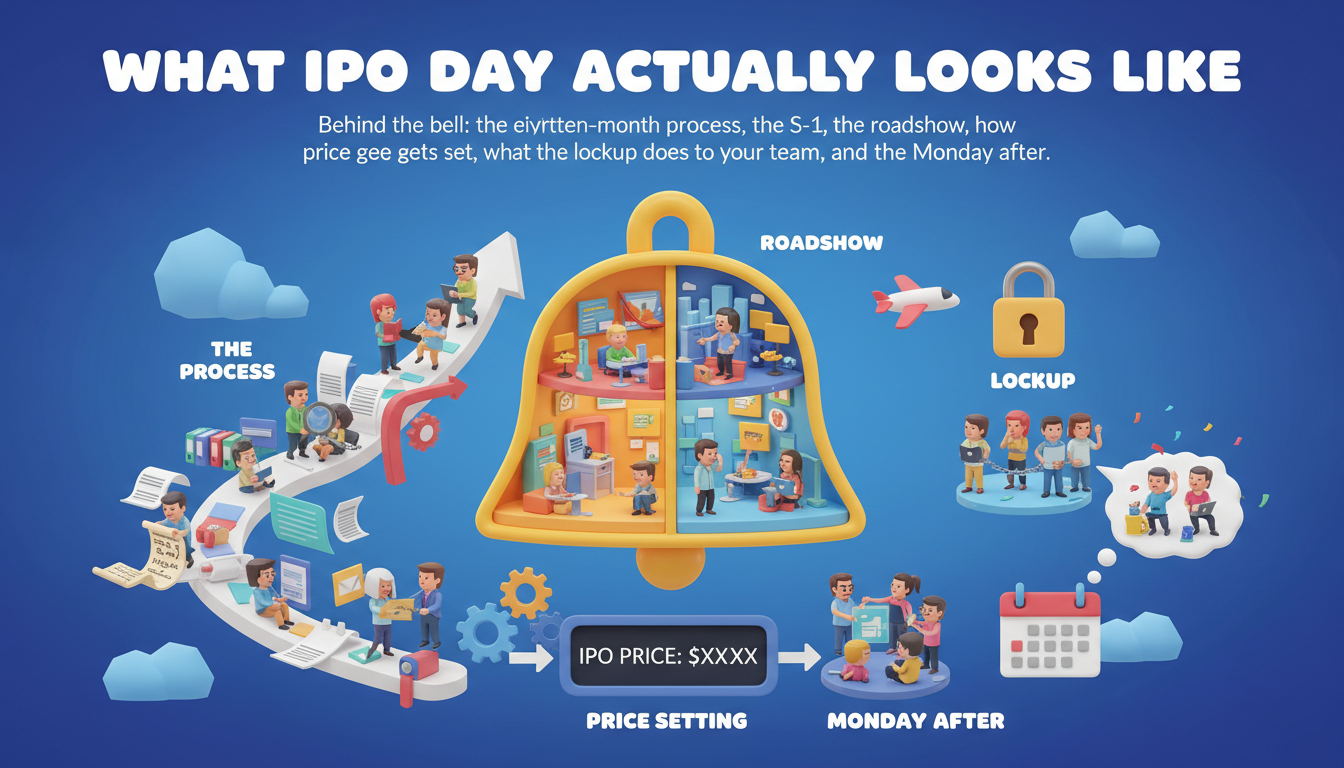
The bell is ninety seconds of television at the end of an eighteen-month process that almost nobody outside the company sees. Here is what the rest of it involves.
Twelve to eighteen months before: becoming auditable
Long before bankers appear, the company has to become the kind of entity public markets will accept. That means three years of audited financials under proper accounting standards, revenue recognition that survives scrutiny, internal controls documented to Sarbanes-Oxley standards, a CFO who has done this before, an audit committee with independent directors, and every messy early-stage arrangement — handshake equity, unpapered contractor deals, the cap table error from 2019 — cleaned up.
This phase is unglamorous and expensive, and it is where most would-be IPOs quietly stall.
The S-1: the most honest document your company will ever publish
The registration statement runs a few hundred pages. Financial statements, management discussion, executive compensation, major shareholders, and the risk factors section — pages of plainly stated ways the business could fail, written by lawyers who are protecting the company by being pessimistic in public.
It is filed confidentially first, the SEC comes back with comments, you revise, and eventually it goes public. From that moment your competitors, your customers and your employees can read your margins.
The roadshow
Two weeks, a dozen cities or a wall of video calls, the same 45-minute presentation delivered up to eight times a day to institutional investors. The management team is answering the same six questions until the answers are reflexes.
Meanwhile the bank builds the order book: who wants how many shares, at what price. That book is what sets the number.
Pricing night
The evening before trading, the company and its bankers set the offer price. Demand from the book on one side, the desire for a stable first day on the other.
Price too low and you leave money on the table — a 40 percent first-day pop means the company sold shares for far less than buyers would have paid, and the difference went to whoever received the allocation. Price too high and the stock breaks issue, the headline is negative, and the employees watching their first vest are demoralised in week one.
The tension is real and never fully resolved.
The first trade
The bell is ceremonial. The actual event is the opening auction, where buy and sell orders cross and the market sets a price that may be nothing like the offer price. Existing shareholders did not get liquidity — they got a public quote on shares they still cannot sell.
The lockup
For roughly 180 days, insiders cannot sell. Then, on one date, a large volume of employee shares becomes eligible at once. Expect two things: a price dip around expiry, and a wave of resignations from people who were waiting.
Companies that handle this well plan retention grants long before the date. Companies that don't discover that half their senior engineers had a countdown running.
The Monday after
Everything changes structurally:
- Quarterly earnings. You now guide, and missing guidance by a small margin can cost billions in market cap in an afternoon.
- Disclosure discipline. Material information becomes a legal matter, not a communications preference.
- A visible scoreboard. Every employee can check the company's price between meetings. Morale becomes partially outsourced to the market.
- New shareholders. Index funds, hedge funds, eventually activists — owners who never met you and owe you no patience.
An IPO is not an exit. It is a financing event that converts a private company with patient owners into a public one with impatient ones. Founders who treat it as a finish line spend the following year confused about why the hard part just started.
Common questions
- How long does an IPO take?
- Typically 12 to 18 months of preparation before the filing, then roughly three to four months from confidential submission to the first trade.
- What is the lockup period?
- Usually 180 days after listing, during which employees and insiders cannot sell. It is the single most disruptive period for retention.
- Why do IPOs pop on day one?
- Shares are priced to be allocated to institutions who want an immediate gain. A large pop means the company sold its stock below what the market would have paid.