Earn-Outs, Escrow, and Why the Headline Number Is Not What You Get
A worked walk from a $60M announcement down to what actually lands in a founder bank account, and which terms to fight for.
"Acquired for $60 million" is a press release, not a bank statement. Between the two sit six deductions, and founders who have not modelled them before signing routinely discover the outcome is a third of what they told their family.
The waterfall, in order
Here is a realistic deal. Company sells for $60M having raised $22M across a seed and Series A, both with 1x non-participating preferences. Founders hold 38% of common.
| Step | Amount | Running total | | --- | --- | --- | | Headline price | $60,000,000 | $60,000,000 | | Transaction costs (banker, legal, accounting ~4%) | -$2,400,000 | $57,600,000 | | Escrow holdback (12%, 18 months) | -$7,200,000 | $50,400,000 | | Earn-out (25%, contingent on two-year targets) | -$15,000,000 | $35,400,000 | | Preference stack (1x on $22M) | -$22,000,000 | $13,400,000 | | Retention pool for employees | -$2,000,000 | $11,400,000 | | Available to common at close | $11,400,000 | | | Founders' 38% share at close | $4,332,000 | |
Before tax. From a $60M announcement. The escrow and the earn-out may eventually pay out and lift that figure substantially — or may not.
Escrow: expect it, negotiate the edges
Escrow is money held back to cover claims if the representations you made turn out to be wrong. It is standard and not worth fighting in principle.
Worth negotiating:
- Amount. 10-15% is normal. Above 20% is aggressive.
- Duration. 12-18 months. Longer means your money is tied up through an integration you no longer control.
- Caps and baskets. A cap limits total liability, ideally to the escrow. A basket sets a minimum threshold before any claim can be made.
- Representation and warranty insurance. Increasingly common and can materially reduce or replace escrow. Ask for it.
Earn-outs: assume you will not receive it
An earn-out ties part of the price to post-close performance. It exists because the buyer and seller disagree on value, and it resolves the disagreement by transferring the risk to you — after you have handed over control of the levers.
Structural problems to understand before agreeing:
- You no longer control pricing, hiring, roadmap or sales compensation, all of which drive the targets.
- The buyer may reorganise your team, merge your product line, or change the sales motion in ways that make the targets unreachable without anyone acting in bad faith.
- Revenue attribution becomes ambiguous the moment the products are sold together.
If an earn-out is unavoidable:
- Tie it to the simplest possible metric — gross revenue of the acquired product, not contribution margin or a bespoke definition.
- Keep the period short, twelve months rather than three years.
- Write in operating covenants: agreed budget, headcount and pricing autonomy for the earn-out period.
- Insist on acceleration if you are terminated, the product is discontinued, or the business is resold.
- Make it tiered, not all-or-nothing. A cliff target means missing by 2% pays zero.
Then value the company as though the earn-out is worth zero and decide whether you would still sign.
Cash versus stock
Buyer stock is a second investment decision disguised as a payment.
| Consideration | Cash | Public buyer stock | Private buyer stock | | --- | --- | --- | --- | | Certainty | Complete | Market risk, lock-up | Illiquid, possibly for years | | Tax timing | At close | Often at close | Depends on structure | | Upside | None | Real | Real but unrealisable |
For a private buyer's stock, ask the questions you would ask as an investor: their cap table, preference stack, runway and last valuation. You are becoming a minority shareholder with no control, and people accepting private stock as the bulk of consideration are making a venture investment they did not intend to make.
Your own retention package
Almost every deal includes a retention agreement for founders and key staff, typically one to three years of vesting on new buyer equity. Treat it as a separate negotiation from the purchase price, because it is compensation, not proceeds — and because a buyer trading purchase price for retention equity is shifting risk onto you again.
Common mistakes
- Modelling proceeds only at the headline price. Model close-date cash separately from contingent value.
- Accepting the buyer's definition of earn-out revenue. Definitions are where earn-outs are won and lost.
- Not reading the preference stack. Participating preferred, multiple liquidation preferences or a stacked cap table can leave common with very little.
- Forgetting employee outcomes. Your team's options may be underwater at the deal price. Negotiate a retention or acceleration pool explicitly.
- Signing exclusivity too early. Exclusivity removes your leverage before the price is settled.
How the simulator models it
Garage to IPO models liquidation preferences and the payout waterfall directly, so a headline exit does not automatically translate into founder wealth. Selling after heavy dilution at an unfavourable preference structure produces exactly the result it produces in reality: a large valuation and a modest personal outcome.
Model your own outcome before the negotiation
Do this in a spreadsheet, privately, before any conversation about price. Three columns: a low, expected and high offer. For each, run the full waterfall down to your personal, post-tax proceeds.
| Line | Low ($35M) | Expected ($60M) | High ($85M) | | --- | --- | --- | --- | | Transaction costs | -$1.4M | -$2.4M | -$3.4M | | Escrow (12%) | -$4.0M | -$7.2M | -$9.8M | | Earn-out held back | -$8.8M | -$15.0M | -$21.3M | | Preference stack | -$22.0M | -$22.0M | -$22.0M | | Retention pool | -$2.0M | -$2.0M | -$2.0M | | To common at close | -$3.2M | $11.4M | $26.5M |
The low column is the useful one. In this structure, a $35M sale returns nothing to common shareholders at close — the founders would work through an integration and a two-year earn-out for the possibility of a payout. Knowing that number in advance changes which offers you take seriously, and it tells you precisely which term to negotiate hardest: here, the preference stack and the earn-out proportion matter far more than another few million on the headline.
Where to go next
Read how acquisition offers are priced for where the headline comes from, and life after the sale for what happens once it closes.
Common questions
- How much of an acquisition price is typically held in escrow?
- Usually 10-15% for twelve to eighteen months. Representation and warranty insurance can reduce or replace it and is worth asking for.
- Should I accept an earn-out?
- Only if you would still sign assuming it pays nothing. You lose control of the levers that drive the targets, so keep the period short, the metric simple, and include acceleration if you are terminated.
- Why do founders receive so much less than the headline price?
- Transaction fees, escrow, contingent earn-out, the investor liquidation preference stack, employee retention pools and tax all come out before common shareholders are paid.
Keep reading
Life After the Sale: Lock-Ups, Earn-In Years, and What Founders Do Next
The integration year, the money decisions that cannot be undone, and why the identity problem hits harder than the financial one.
How Acquisition Offers Are Actually Priced
Strategic buyers, financial buyers and acquihires value the same company completely differently. Here is what each is paying for, and how the number is built.
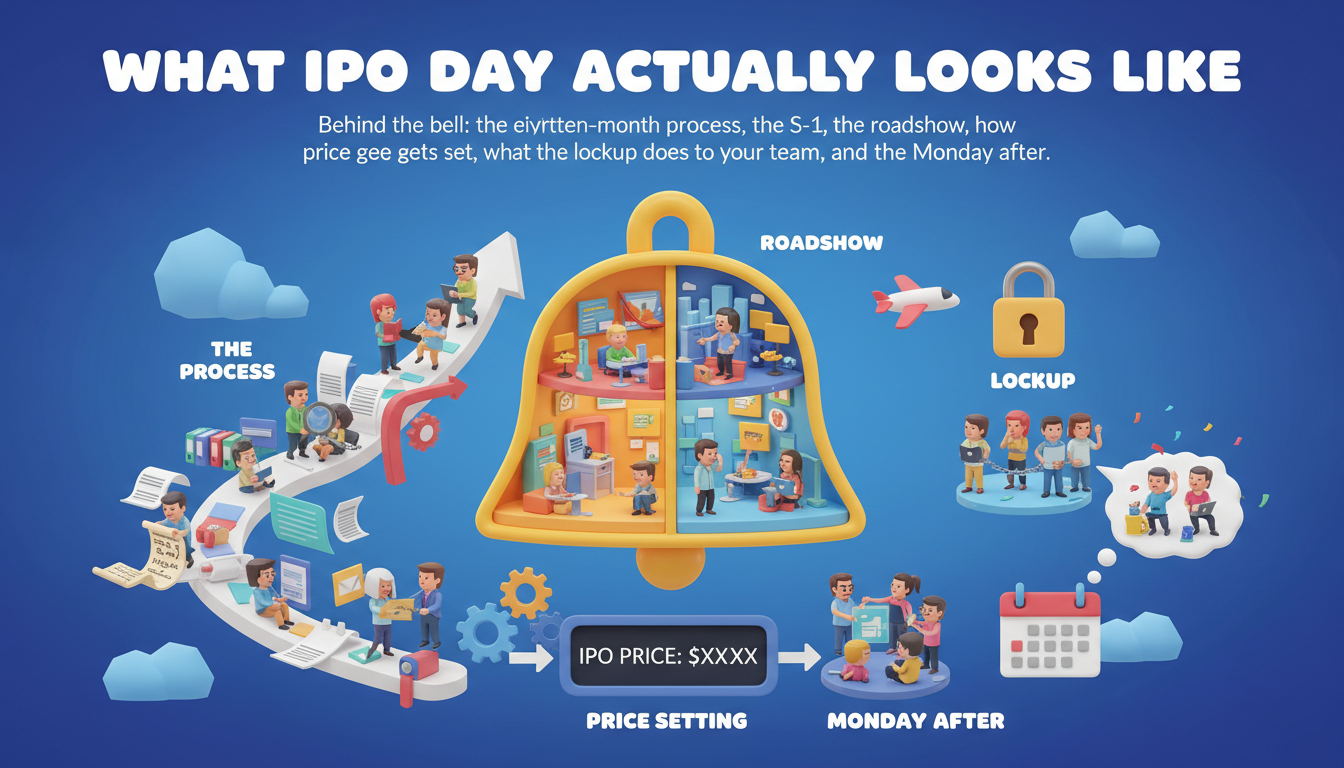
What IPO Day Actually Looks Like
Behind the bell: the eighteen-month process, the S-1, the roadshow, how the price gets set, what the lockup does to your team, and the Monday after.