Runway Planning and Knowing When to Cut
The decision founders delay longest and regret most. Trigger points, the three levers, and how to make one cut instead of three.
Almost every founder who has made cuts says the same two things: they should have done it three months earlier, and they should have cut deeper. The delay is not stupidity — it is hope, plus the reasonable belief that the next month will be better. A pre-agreed trigger system removes hope from the decision.
Model runway forwards, not backwards
Dividing cash by last month's burn is the wrong calculation, because burn is rarely flat. Build a month-by-month projection with the hires, the annual bills and the planned spend increases in it.
| Month | Cash start | Net burn | Cash end | | --- | --- | --- | --- | | 1 | $3,000,000 | $210,000 | $2,790,000 | | 2 | $2,790,000 | $245,000 (new hires) | $2,545,000 | | 3 | $2,545,000 | $290,000 (annual insurance) | $2,255,000 | | 4 | $2,255,000 | $265,000 | $1,990,000 | | ... | | | |
Naive maths said 14 months. The planned curve says closer to 11. That three-month difference is the whole decision.
Run three scenarios every month: base, downside (growth flat, 20% slower collections) and upside. The downside is the one that should drive hiring decisions.
Set the trigger points in advance
Write these down in a good month, while you are calm, and hold yourself to them.
| Runway remaining | Action required | | --- | --- | | 18 months | Normal operation; plan the raise story | | 12 months | Freeze non-critical hiring; begin raise preparation | | 9 months | Start the raise, or decide to cut and reach profitability | | 6 months | Cut decisively to reach 15+ months; no half measures | | 3 months | Emergency: bridge financing, sale process, or wind-down |
The nine-month line matters most. A raise takes three to six months, and you must be able to walk away from a bad term sheet. Raising with four months of cash means accepting whatever is offered.
The three levers, in order of speed
1. Spend that is not people. Immediate, painless, and rarely enough on its own — but always do it first, because cutting staff while keeping a $4,000-a-month tool nobody uses destroys trust.
- Unused software (typically 15-25% of the tooling bill)
- Agencies and contractors
- Marketing spend in channels with payback beyond your runway
- Cloud costs — reserved instances, dropping unused environments, right-sizing
2. Price and collections. Faster than founders expect and often overlooked.
- Raise prices for new customers; grandfather existing ones
- Offer annual prepay at a 15-20% discount — a cash flow lever disguised as a discount
- Invoice on signature, chase receivables weekly, shorten payment terms
3. Headcount. The slowest to decide and the fastest to change the numbers.
If you cut people, cut once
The evidence from operators is consistent on this: multiple rounds of cuts do more damage than one larger one. Everyone who survives round one spends round two updating their CV rather than working.
Principles that hold up:
- Cut to a level that gives you 15+ months of runway on the downside scenario, not the base case.
- Decide by role and function, not by individual performance ranking alone — you are reshaping the company, not conducting reviews.
- Do it in one day, in the morning, with severance decided before the conversations start.
- Tell the remaining team the full picture the same day: what happened, why, the new runway number, and that this is the only cut.
- Founders take the same or a deeper pay cut. It is noticed.
What cutting costs you
Be honest with yourself about what you are giving up, because it informs how deep to go:
- Roadmap items that will now not ship, and the revenue attached to them
- Sales capacity, and therefore growth rate — which affects the next round's story
- Institutional knowledge, which does not come back with a rehire
- Recruiting reputation for the following twelve months
This is why shallow cuts are so costly: you pay all of these prices and still have to do it again.
Common mistakes
- Cutting marketing first, entirely. Zeroing acquisition saves cash and removes the growth that makes the next raise possible. Cut inefficient channels, keep the ones that pay back.
- Waiting for the quarter to end. The runway does not care about your calendar.
- Assuming a bridge round is available. Existing investors fund companies with momentum, not companies out of money.
- Hiring against a pipeline that has not closed. Payroll is permanent; a verbal is not.
- Hiding the numbers from the team. People model the worst case in the absence of information, and the best ones leave first.
How the simulator models it
Cash is the binding constraint in Garage to IPO, exactly as it is in life. The game rewards players who cut early and raise from strength, and punishes the very human instinct to spend into a slowdown hoping growth returns. Watching a run end with a strong product and an empty bank account is an unusually memorable lesson.
Communicating a cut, and the weeks after
The decision is only half the work. How it is executed determines whether the surviving company functions.
On the day: deliver the news in person where possible, early in the morning, individually. State clearly that it is a company decision about roles and finances, not a judgement of the person. Have severance terms, final pay dates, equity treatment and reference commitments written down and handed over in the same conversation. Access changes should be handled with dignity, not by cutting off accounts mid-sentence.
Same day, with the remaining team: full context. How much cash, what the new runway is, what the plan buys, what happens if it does not work, and an unambiguous statement of whether more cuts are anticipated. If you cannot honestly say this is the last one, say that instead of promising otherwise — one broken reassurance costs more trust than the cut itself.
The following weeks: expect reduced output for a month, help departing colleagues find roles publicly and genuinely, and rewrite the plan with the team so that the remaining people are building the new version rather than mourning the old one. Companies that recover quickly are almost always the ones that replaced the old plan with a specific new one within a fortnight.
Where to go next
Ground the numbers with burn rate math every founder should know, and read reading your P&L for where the burn figure actually comes from.
Common questions
- How much runway should I have before starting a raise?
- At least nine months. A raise takes three to six months and you need enough cash left to walk away from a bad term sheet.
- How deep should a cost cut go?
- Deep enough to reach fifteen or more months of runway under a downside scenario, not the base case. Shallow cuts usually lead to a second round, which damages the team far more.
- Should marketing be the first thing cut?
- Only the channels whose payback period is longer than your runway. Zeroing acquisition entirely removes the growth that makes the next raise possible.
Keep reading
Hiring Your First Finance Person (And What to Do Until Then)
Bookkeeper, controller, VP Finance or CFO — who you need at each stage, what each costs, and the finance stack that carries you until you need any of them.
Reading Your P&L: What Founders Misread Every Month
Bookings are not revenue, gross margin is not price minus hosting, and profit is not cash. A line-by-line walk through the statement founders skim.
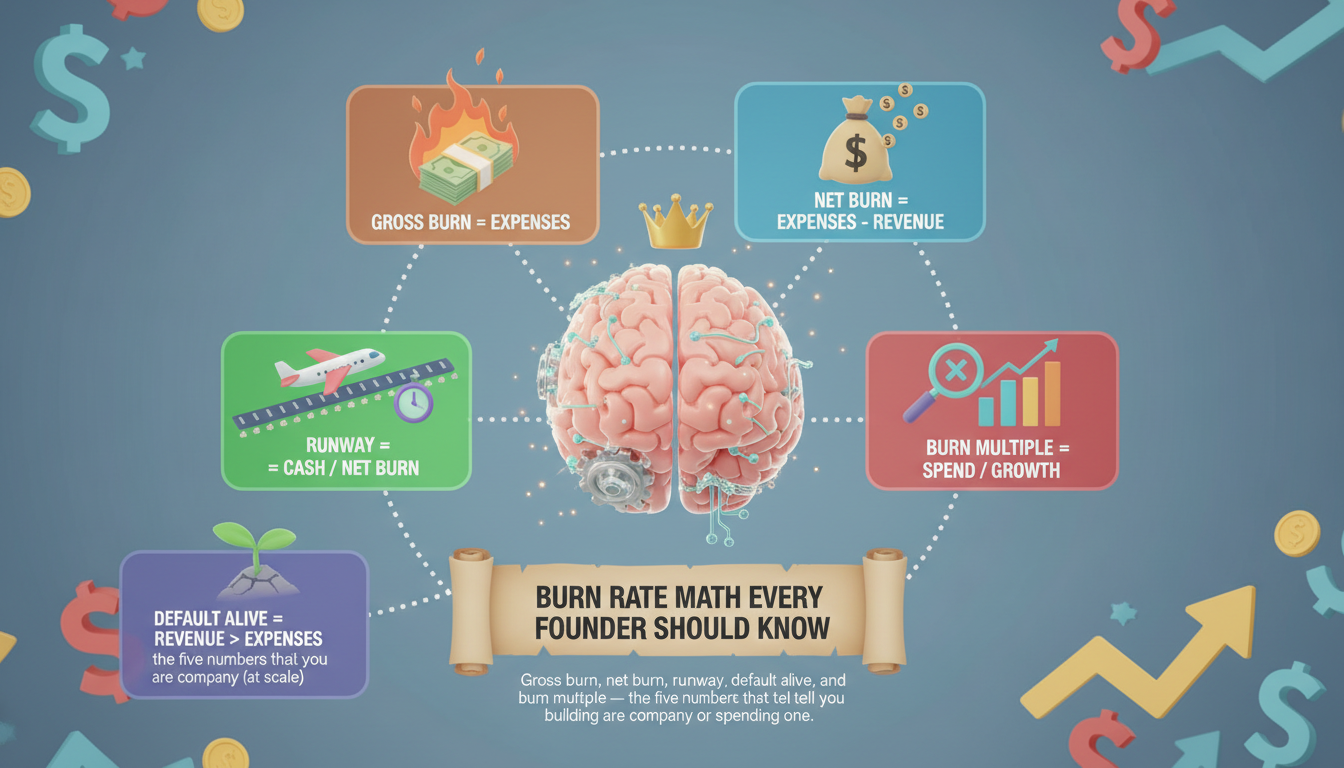
Burn Rate Math Every Founder Should Know
Gross burn, net burn, runway, default alive, and burn multiple — the five numbers that tell you whether you are building a company or spending one.