Burn Rate Math Every Founder Should Know
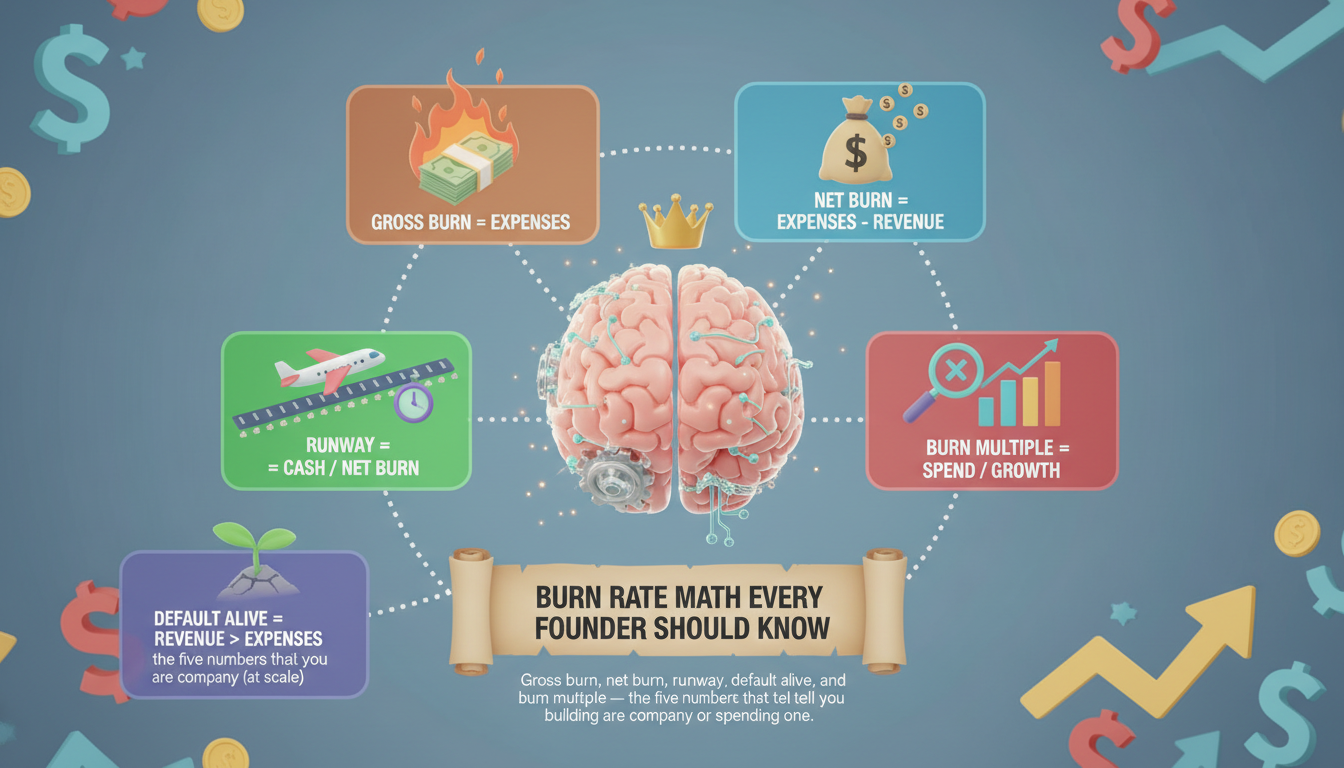
Gross burn, net burn, runway, default alive, and burn multiple — the five numbers that tell you whether you are building a company or spending one.
Most startups do not fail because the product was wrong. They fail because the founders were wrong about how much time they had left. Here are the five numbers that answer that question, with the arithmetic done.
1. Gross burn
Everything you spend in a month. Salaries, cloud, tools, rent, contractors, the annual plan you paid for in January divided across twelve.
If payroll is $180,000, infrastructure is $12,000 and everything else is $18,000, gross burn is $210,000 per month.
2. Net burn
Gross burn minus cash actually collected. Not invoiced — collected. Collection lag is where optimistic founders get hurt.
With $210,000 gross burn and $90,000 collected, net burn is $120,000 per month.
3. Runway
Cash in the bank divided by net burn.
$1,440,000 ÷ $120,000 = 12 months.
The mistake is treating this as a static number. If you are hiring, next month's burn is higher, and 12 months is closer to 9. Always model runway against your planned burn curve, not last month's.
4. Default alive
Paul Graham's question: if you change nothing — no new hires, no new spend — does your current growth rate get you to profitability before the money runs out?
Take $90,000 monthly revenue growing 12 percent per month against $210,000 of costs. Revenue passes costs in month eight. You have twelve months of runway. You are default alive.
Same revenue growing 4 percent per month reaches $210,000 in month 22. You have twelve months. You are default dead, and no amount of energy changes that arithmetic — only a raise, a price increase, or a cut does.
Every founder should know which one they are, this week, without opening a spreadsheet.
5. Burn multiple
Net burn divided by net new ARR in the same period. It answers: how many dollars are we burning to add one dollar of recurring revenue?
$120,000 of net burn producing $80,000 of net new ARR in a quarter is a burn multiple of 1.5.
- Under 1 — exceptional
- 1 to 1.5 — strong
- 1.5 to 2 — acceptable early
- 2 to 3 — watch it
- Above 3 — you are buying growth, and the price goes up
Unlike growth rate, this number cannot be flattered by spending more. That is exactly why investors ask for it.
Where runway disappears without anyone noticing
- Annual contracts booked as monthly revenue. Cash came in once; the spreadsheet says it recurs.
- Hires counted at salary. Fully loaded cost is typically 1.25 to 1.4x salary once tax, benefits, equipment and software are included.
- Cloud costs that scale with usage. Success raises burn. Model infrastructure as a percentage of revenue, not a fixed line.
- The raise that takes longer than planned. Three months of process is optimistic; six is common. Runway is measured to the close, not to the first meeting.
The only rule that matters
Start raising when you have at least nine months of runway left. Not six. Nine months means you can walk away from a bad term sheet. Six months means the other side knows you can't, and they will price accordingly.
Runway is not a finance metric. It is the amount of negotiating leverage you have left, denominated in time.
Common questions
- What is a healthy burn multiple?
- Under 1.5 is strong, 1.5 to 2 is acceptable at early stage, and above 3 usually means growth is being bought rather than earned.
- How much runway should you keep?
- Plan to start raising with at least nine months left, because a raise typically takes three to six months and you need the option to walk away.
- Does profitability mean you should stop raising?
- No, but being default alive turns every future raise into a choice instead of a rescue.
Keep reading
Your First Ten Hires Decide Everything
The first ten people set your culture, your speed, and your ceiling. A hiring order that works, the roles founders hire too early, and how to fire fast without being cruel.