Your First Ten Hires Decide Everything
The first ten people set your culture, your speed, and your ceiling. A hiring order that works, the roles founders hire too early, and how to fire fast without being cruel.
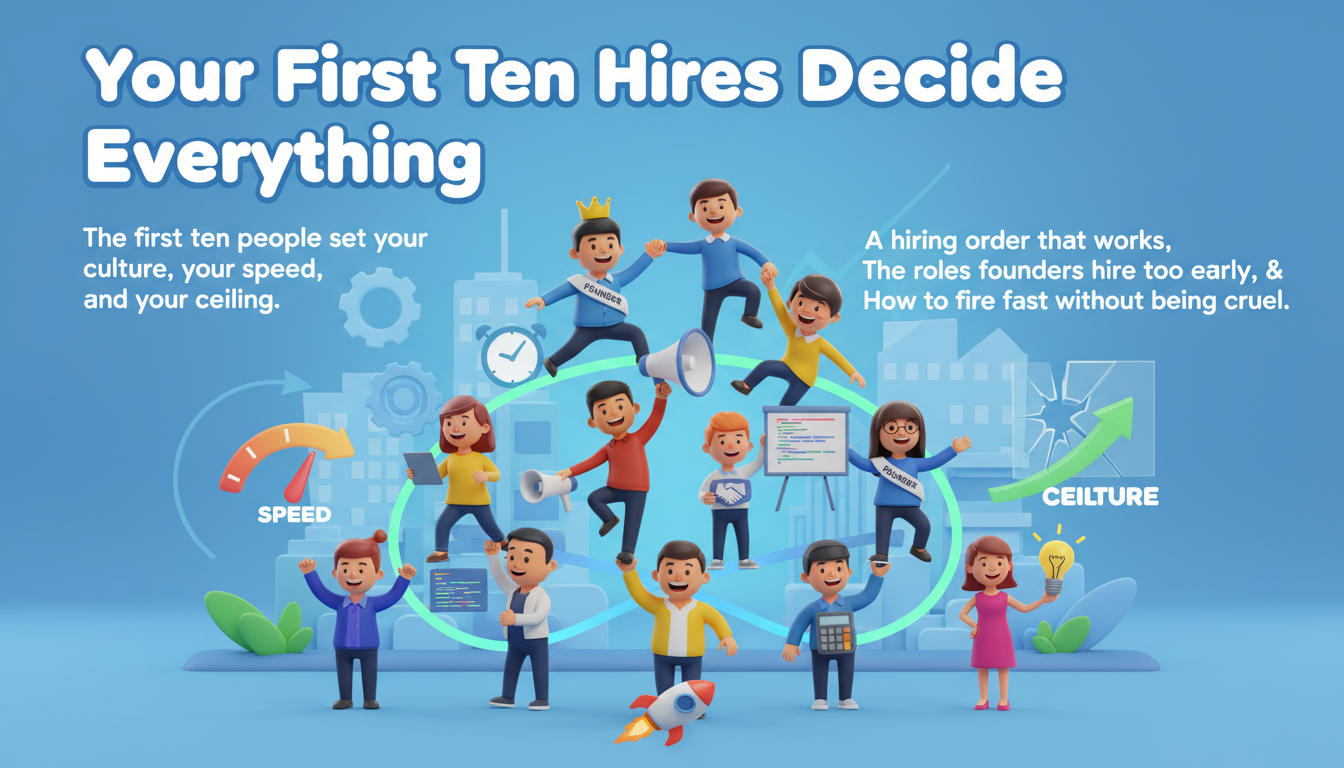
At ten people your company has a personality, and you did not choose it deliberately — it emerged from the ten individuals you happened to hire. Everything after that is inheritance. This is why the first ten hires matter more than any product decision you make in the same period.
A hiring order that survives contact with reality
There is no universal sequence, but there is a shape that works for most software companies:
- Second builder. Someone who can ship without a spec. Whatever the founders cannot build, this person covers.
- Third builder. Two engineers is a bus-factor problem; three is a team.
- Generalist operator. Support, onboarding, billing, vendor chaos. Buys the founders back fifteen hours a week.
- Designer or design-minded engineer. The point where the product stops looking like an internal tool.
- First real salesperson — after the founders have closed enough deals to describe the motion in a document.
- Customer success. The moment churn becomes visible, not after it hurts.
- Senior engineer with production scars. Someone who has been paged at 3am and knows what to build differently.
- Marketer who can write. Content, positioning, launches. Not an agency manager.
- Second salesperson. Confirms the first was not a fluke — or reveals that they were.
- The gap you can now see. By ten you know what is breaking. Hire that.
The roles founders hire too early
A sales leader before sales exists. A VP of Sales builds and manages a team executing a known playbook. If the playbook does not exist, you have hired an expensive person to invent something they were not hired to invent. They will fail, and it will cost you a year.
A project manager instead of fewer projects. Process usually treats a symptom of doing too many things at once.
Anyone whose job is entirely coordination. Below twenty people, coordination is a founder task.
A cheap junior to save money. Early-stage juniors need mentorship the company has no capacity to provide. The savings evaporate inside a quarter.
Hire for slope, not position
At ten people, the person's current skill level is less predictive than how fast they improve. The company will be unrecognisable in a year; you need people who will be unrecognisable too.
Practical filters:
- Paid work trial over interviews. A day or a week of real work tells you more than five conversations.
- Ask what they changed their mind about. People who cannot answer do not update, and everything in an early company is an update.
- Check how they behave with ambiguity, not how they solve a clean problem. You have no clean problems.
Firing fast, done decently
Every founder is told to fire fast. Almost nobody does, because the advice sounds like permission to be callous, and it feels like admitting your own mistake — which it usually is.
Do it this way:
- Be explicit the first time you notice. Most "bad hires" were never told clearly what was wrong.
- Give a concrete 30-day picture of what good looks like, and actually coach.
- If it has not moved, act. Generous severance, an honest reference for the things they are genuinely good at, and no theatre about "not a culture fit."
Keeping someone in a role they are failing at is not kindness. It costs them a year of their career and costs the other nine people their trust that performance means anything here.
The compounding part
Great early hires attract great later hires and set the standard for what shipping looks like. A single mediocre hire in the first ten sets a ceiling, because everyone calibrates against the weakest person you tolerated. That is the whole argument for being slow to hire and quick to correct: at this size you are not filling roles, you are writing the constitution.
Common questions
- Should the first hire be a salesperson?
- Usually no. Founders should sell until the process is repeatable enough to hand over, because early sales calls are product research.
- When do you need a manager?
- Around 12 to 15 people, when the founders can no longer hold every thread. Hiring managers before there is anything to manage adds process without output.
- How long should a bad hire last?
- If the concern is capability and coaching has not moved it in 30 to 60 days, act. Waiting protects nobody, least of all the person.
Keep reading
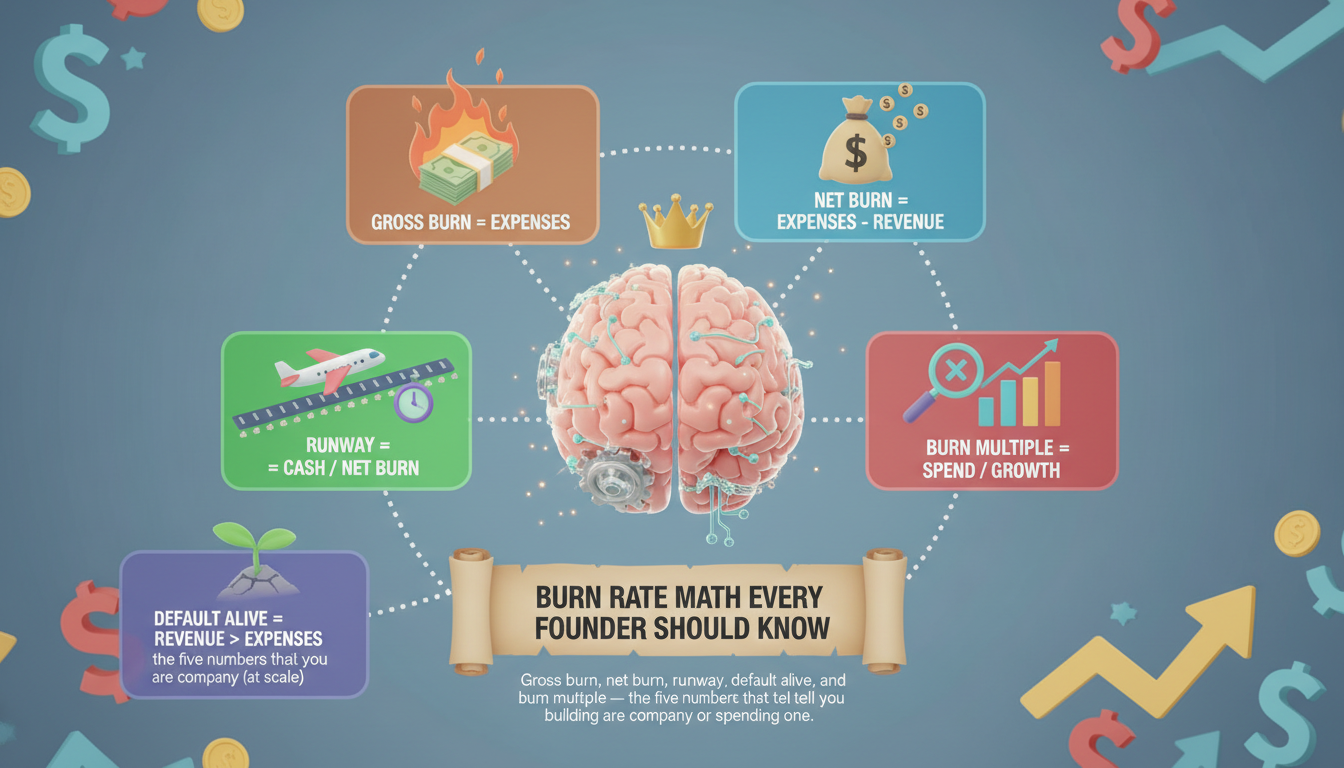
Burn Rate Math Every Founder Should Know
Gross burn, net burn, runway, default alive, and burn multiple — the five numbers that tell you whether you are building a company or spending one.