Reading Your P&L: What Founders Misread Every Month
Bookings are not revenue, gross margin is not price minus hosting, and profit is not cash. A line-by-line walk through the statement founders skim.
Most founders can recite their MRR and their burn and could not explain the gap between the two. The profit and loss statement is where that gap lives, and reading it properly takes about twenty minutes a month. Here it is, line by line, with the mistakes that hide in each one.
The shape of the statement
| Line | Example month | Notes | | --- | --- | --- | | Revenue | $420,000 | Recognised, not billed | | Cost of revenue | $92,000 | Hosting, support, payment fees, delivery | | Gross profit | $328,000 | 78% margin | | Sales and marketing | $145,000 | | | Research and development | $180,000 | Engineering and product | | General and administrative | $63,000 | Finance, legal, office, insurance | | Operating income | -$60,000 | The real operating result | | Net income | -$64,000 | After interest and tax |
Revenue: bookings, billings and recognised revenue are three things
This is the most common confusion and the most consequential.
- Bookings — the value of contracts signed. A $120,000 annual deal signed today is $120,000 of bookings.
- Billings — what you invoiced. Possibly all $120,000 up front.
- Revenue — what you earned this period. That contract produces $10,000 of revenue per month for twelve months.
Announcing the $120,000 as revenue overstates the month twelvefold and creates a deferred revenue liability you may not have recorded. Investors check this immediately, and a founder who conflates the three loses credibility in a single sentence.
Cost of revenue: be honest about what belongs here
Cost of revenue is everything required to deliver the product to a paying customer: infrastructure, third-party APIs consumed per customer, payment processing, support staff, and the customer success headcount whose job is keeping the current service running.
What does not belong: engineering building new features, sales, or general overhead.
The temptation is to push costs down into operating expenses to flatter gross margin. It fools nobody who matters and it removes your ability to see whether the product's economics are actually improving.
| Margin | Typical business | | --- | --- | | 75-85% | Healthy SaaS | | 50-70% | SaaS with heavy support or infrastructure | | 30-50% | Marketplace or services-heavy model | | Under 30% | Priced wrong, or you are running a services business |
R&D, and the capitalisation question
Most early-stage companies expense all engineering, and that is usually right. Capitalising development costs moves spend off the P&L and onto the balance sheet as an asset, which makes profitability look better and is entirely legitimate under certain conditions — but it obscures your real burn, and a sophisticated reader will add it back anyway. Expense it and see the truth.
G&A: the line that grows without anyone deciding
Software subscriptions, legal fees, accounting, insurance, recruiting fees, office. Individually every item is small and defensible; collectively it is where 10-15% of spend disappears without a decision ever being made. Review the full vendor list quarterly. Founders who do this routinely cut 20-30% the first time and are surprised by what they find.
Profit is not cash
The most important thing the P&L does not tell you. Four reasons the two diverge:
- Accounts receivable. Revenue recognised on an invoice that has not been paid is profit without cash.
- Deferred revenue. Annual prepayment is cash without profit — and it is a liability, because you owe eleven more months of service.
- Capital expenditure. Equipment purchases hit cash immediately and the P&L slowly through depreciation.
- Loan principal repayments. Cash out, not an expense.
A company can be profitable on paper and insolvent in practice. This is why the cash flow statement exists, and why runway is computed from cash, never from net income.
The four numbers to check every month
- Gross margin trend. Improving means scale is working. Declining while revenue grows means you are selling something that costs more to deliver than you thought.
- Revenue per employee. A blunt but honest efficiency measure. $150k-$200k is typical early; healthy companies climb from there.
- Burn multiple. Net burn divided by net new ARR. Under 1.5 is strong; above 3 means growth is being bought rather than earned.
- Operating expense as a share of revenue, by category, over time. The direction matters more than the level.
Common mistakes
- Recognising annual contracts in one month. Flattering, wrong, and instantly spotted.
- Excluding founder salaries once payroll starts. It makes margin look structurally better than it is.
- Comparing this month to last month only. Use a rolling twelve-month view; single months are noisy.
- Managing to net income at seed stage. Gross margin, burn multiple and runway are the meaningful numbers at that point.
- Only looking at the P&L. Without the cash flow statement and the balance sheet you are reading one third of the picture.
How the simulator models it
Garage to IPO separates revenue, costs and cash on purpose. Spending that improves future revenue still reduces this month's cash, and players who manage only the headline revenue figure regularly run out of money while the business appears to be growing. Watching margin and burn together is what separates a run that reaches the IPO stage from one that stalls.
The three statements together
The P&L is one of three, and reading it alone is how founders get surprised.
The balance sheet is a snapshot: what you own, what you owe, and what is left. The lines that matter at startup scale are cash, accounts receivable, deferred revenue and any debt. Deferred revenue in particular is worth watching — a large balance means you are holding customer money for service you have not yet delivered, which flatters your bank balance and understates your future obligations.
The cash flow statement reconciles profit to cash in three sections: operating, investing and financing. It answers the question the P&L cannot, which is where the money actually went. Net income of -$60,000 with cash down $190,000 is a story about receivables, prepayments or debt repayment, and you want to know which.
The link between them: net income flows into the balance sheet's retained earnings; the change in cash on the cash flow statement equals the change in the cash line on the balance sheet. If those do not tie, the books are wrong, and it is better to discover that in a quiet month than during diligence.
Reviewing all three for twenty minutes each month is the smallest habit with the largest return in startup finance.
Where to go next
Turn these numbers into a survival horizon with runway planning and when to cut, and revisit burn rate math every founder should know.
Common questions
- What is the difference between bookings and revenue?
- Bookings are the total value of contracts signed. Revenue is what you earned in the period, so a $120,000 annual contract produces $10,000 of revenue per month rather than $120,000 in the month it was signed.
- What is a healthy gross margin for SaaS?
- Typically 75-85%. Between 50% and 70% suggests heavy support or infrastructure costs, and under 30% usually means the product is priced wrong or the business is really a services business.
- Can a company be profitable and still run out of cash?
- Yes. Unpaid invoices, capital purchases and loan principal repayments all separate profit from cash, which is why runway is always calculated from the bank balance.
Keep reading
Hiring Your First Finance Person (And What to Do Until Then)
Bookkeeper, controller, VP Finance or CFO — who you need at each stage, what each costs, and the finance stack that carries you until you need any of them.
Runway Planning and Knowing When to Cut
The decision founders delay longest and regret most. Trigger points, the three levers, and how to make one cut instead of three.
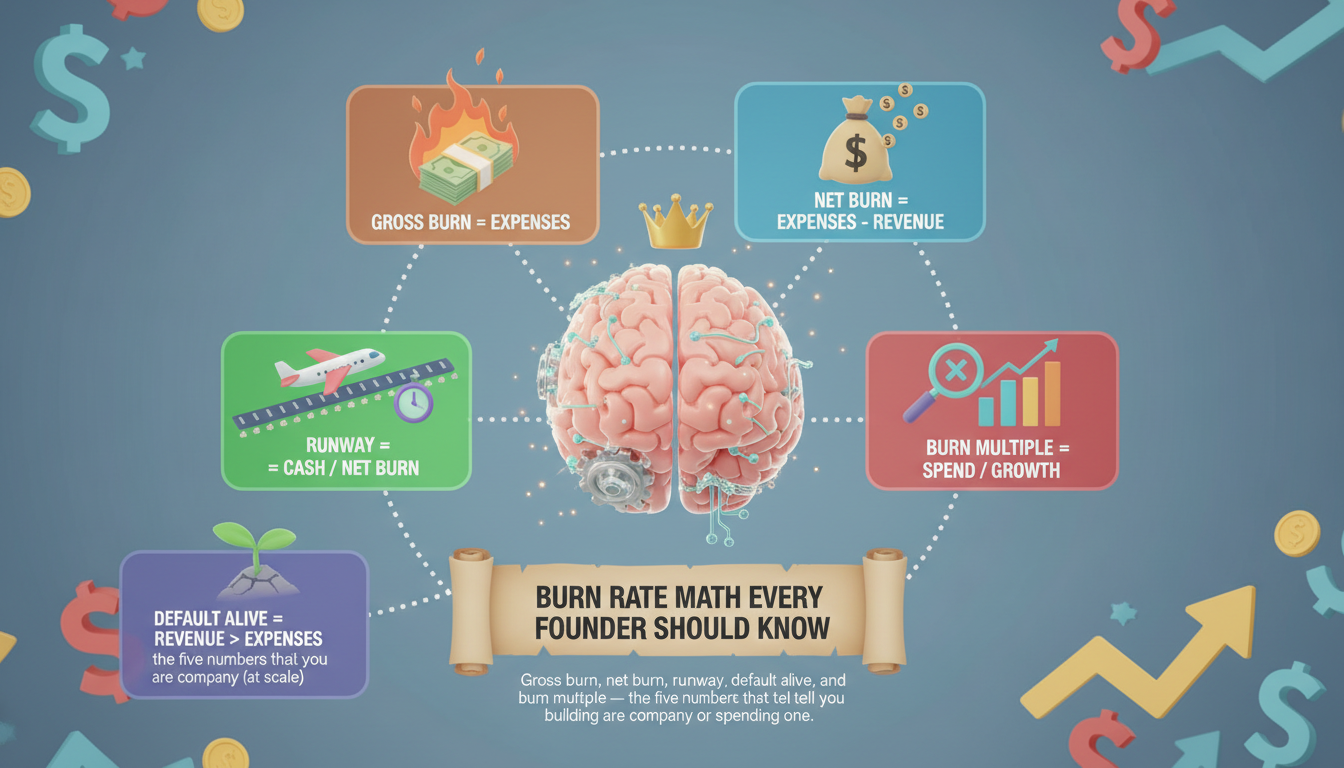
Burn Rate Math Every Founder Should Know
Gross burn, net burn, runway, default alive, and burn multiple — the five numbers that tell you whether you are building a company or spending one.