Raise or Bootstrap: How to Actually Decide
Not a philosophy question. A test based on how fast your market closes, how much capital your product needs before revenue, and what outcome you actually want.
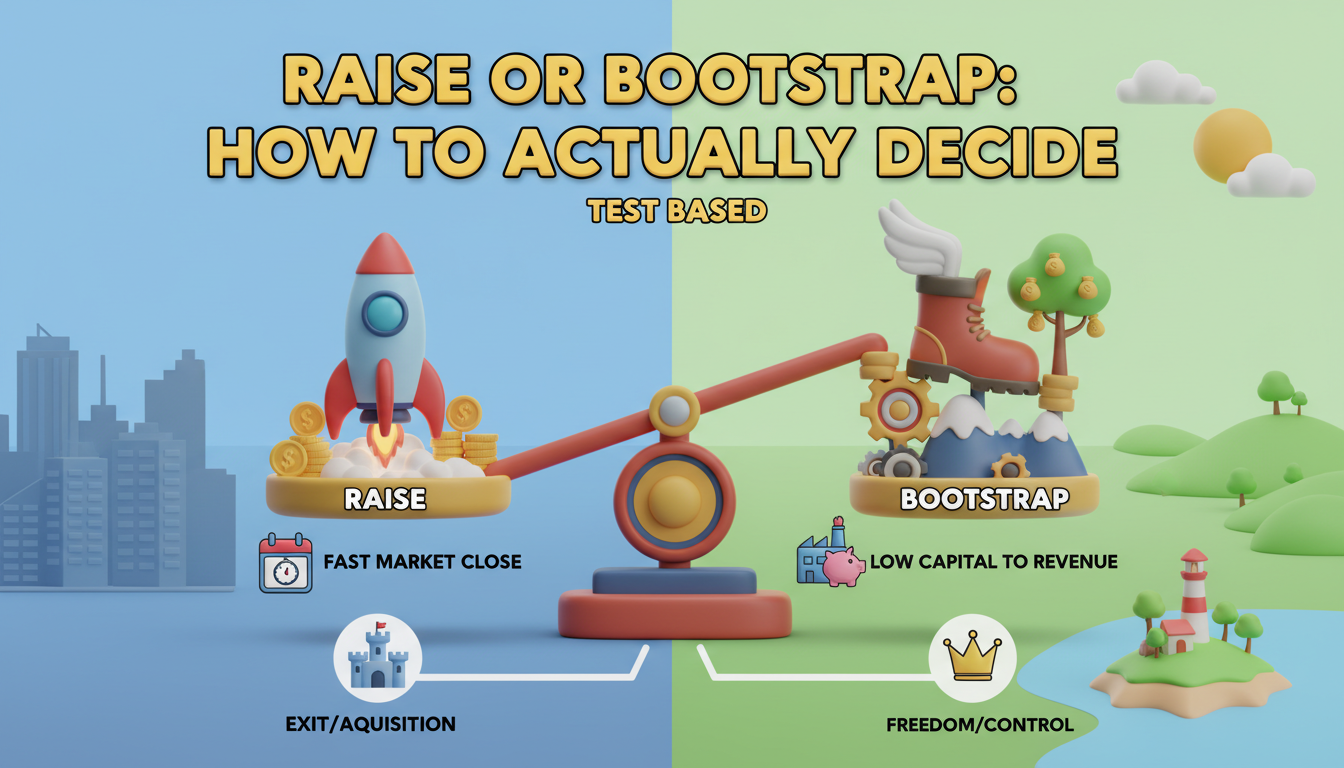
"Should we raise?" is usually asked as an identity question — are we ambitious or are we sensible? It is not. It is a question with three inputs, and once you answer them honestly the decision mostly makes itself.
Input one: does this market close?
Some markets decide their winner quickly and permanently. Network effects, marketplaces, standards, anything where being second means being irrelevant. In those markets, capital buys the only thing that matters, which is time, and a competitor who raises while you bootstrap will simply reach the market before you.
Other markets stay open for decades. Vertical software, tools, services, most B2B niches. Customers switch on merit, and a better product three years later still wins. Raising to sprint in an open market mostly buys expensive impatience.
Ask: if a well-funded competitor launches next quarter, is my business structurally damaged, or merely inconvenienced?
Input two: how much do you have to spend before the first dollar comes back?
Some products cost almost nothing to build and can charge in week three. Others — hardware, regulated fintech, anything clinical — need millions before a customer can legally hand you money. Capital intensity is a fact about your product, not a preference.
If the gap between "start building" and "get paid" is longer than you can personally fund, the decision is already made. The only remaining question is what kind of capital: equity, debt, grants, or a paying design partner willing to fund development.
Input three: what outcome do you actually want?
Be honest, in private, before you are in a room with investors.
A $10M company that you own most of, throws off cash, and runs on thirty hours a week is an excellent life. It is also incompatible with venture funding, whose economics require a small number of enormous outcomes. Taking venture money for a business you intend to keep is how founders end up trapped inside their own success.
Equally, if you want to build something that reshapes an industry, bootstrapping past a certain point is self-sabotage. You will be outspent on distribution by people who understood what game they were playing.
The middle paths people forget
- Bootstrap to revenue, then raise. The strongest position there is. Traction turns fundraising from begging into choosing.
- Revenue-based financing. Non-dilutive capital repaid as a percentage of revenue. Good for predictable software revenue, bad for a land grab.
- Customer-funded development. A design partner who pays for the build. Slower and more constrained, but you keep everything.
- A single small angel round. Enough to remove the day job without committing to a venture-scale outcome — as long as you and the angel agree on that in advance.
The test, in one paragraph
If your market closes fast, or your product cannot earn before it costs millions, and you genuinely want the enormous outcome — raise, and raise properly. If your market stays open, your product can charge early, and what you want is control and cash flow — do not raise, and stop treating that as the lesser choice. Most businesses that should bootstrap raise anyway, because fundraising is the visible, congratulated milestone and revenue is quiet.
The founders who get this right are the ones who wrote the answer down before anyone offered them a term sheet.
Common questions
- Can you bootstrap first and raise later?
- Yes, and it is often the strongest position — revenue before a raise means better terms and a genuine option to say no.
- Which markets require venture money?
- Markets where the winner takes most and speed decides it: network-effect products, hardware, biotech, and anything with heavy regulation or long build cycles before revenue.
- Is revenue-based financing a real alternative?
- For predictable-revenue software businesses, yes. It is non-dilutive but repaid from revenue, so it suits steady growth rather than a land grab.
Keep reading

What a Seed Round Really Costs You
Dilution is only the headline. The real price of a seed round is the board seat, the pace you commit to, and the exit outcomes you quietly rule out.